Key Takeaways:
- Over 55% of first impressions are based on body language alone
- Maintain 60-70% eye contact during interviews
- Use power poses before interviews to reduce stress and boost confidence
- Subtle mirroring builds rapport with interviewers
Introduction
Job interviews are high-stakes situations where your nonverbal communication can influence the outcome as much as your qualifications. In fact, studies show that over 55% of first impressions are based on body language alone. This makes mastering your body language a crucial part of interview preparation.
This comprehensive guide explores how to use body language for job interviews to express confidence, professionalism, and presence. Whether you're attending your first interview or preparing for a leadership role, you'll learn proven strategies to improve your posture, gestures, facial expressions, and tone. The principles covered here complement our broader guide on workplace body language, which explores nonverbal communication across all professional settings.
Quick Answer
Master interview body language through strategic nonverbal communication: maintain 60-70% eye contact, sit with upright open posture, deliver firm handshakes, use controlled gestures at chest level, and subtly mirror the interviewer. With 55% of first impressions based on body language and 33% of hiring managers deciding within 90 seconds, your nonverbal cues can be the deciding factor in landing the job.
Table of Contents
Key Statistics & Research
of first impressions in interviews are based on body language and nonverbal cues rather than what you say
Source: Albert Mehrabian, UCLA research on communication
of hiring managers know within the first 90 seconds whether they'll hire a candidate, based largely on body language
Source: CareerBuilder survey of 2,500+ hiring managers
of employers cited lack of eye contact as a common mistake that costs candidates job offers
Source: Harris Interactive survey on interview mistakes
Use this cheat sheet to build self-awareness and learn the dos and don'ts of nonverbal communication during interviews. A meta-analysis of 63 studies in the Journal of Organizational Behavior found associations between nonverbal cues and interview ratings. These findings concern interviewers' judgments, which can also reflect bias; they do not guarantee hiring success or establish job competence.
Why Body Language Matters in Interviews
Interviewers often make decisions based on subtle cues. Your gestures, eye contact, and voice can either reinforce your message or create doubt. Understanding nonverbal communication and using positive body language helps:
- Build trust and rapport
- Highlight confidence and enthusiasm
- Improve the overall impression you leave
Negative body language can:
- Signal nervousness or lack of confidence
- Appear unprofessional or disengaged
- Distract from your message
Understanding and controlling these cues gives you a strong advantage.
How to Prepare Your Body Language Before the Interview
Record a Mock Interview
Create a video of yourself answering common questions. Review your posture, hand movements, eye contact, and facial expressions. Adjust accordingly to ensure you appear confident and calm.
Practice Power Poses
Use body positions that boost confidence: arms open, chest lifted, chin level. These poses help reduce cortisol (stress) and increase testosterone (confidence).
Dress for the Role
Wear clothing appropriate to the role and industry. Ensure your outfit supports positive posture and limits distractions. Well-fitted clothes also reduce fidgeting.
First Impressions: Entering the Interview Room
The way you enter the interview room sets the tone for the entire interaction. Research shows that first impressions are formed within seconds, making your entrance a critical moment to demonstrate confidence and professionalism.
Walking In
- Maintain upright posture
- Take calm, purposeful steps
- Make eye contact and smile slightly upon entering
Greeting the Interviewer
- Offer a confident, full handshake
- Maintain eye contact while introducing yourself
- Keep your facial expression warm and composed
Sitting Down
- Wait until invited to sit
- Sit upright with your feet flat
- Keep your hands relaxed and visible
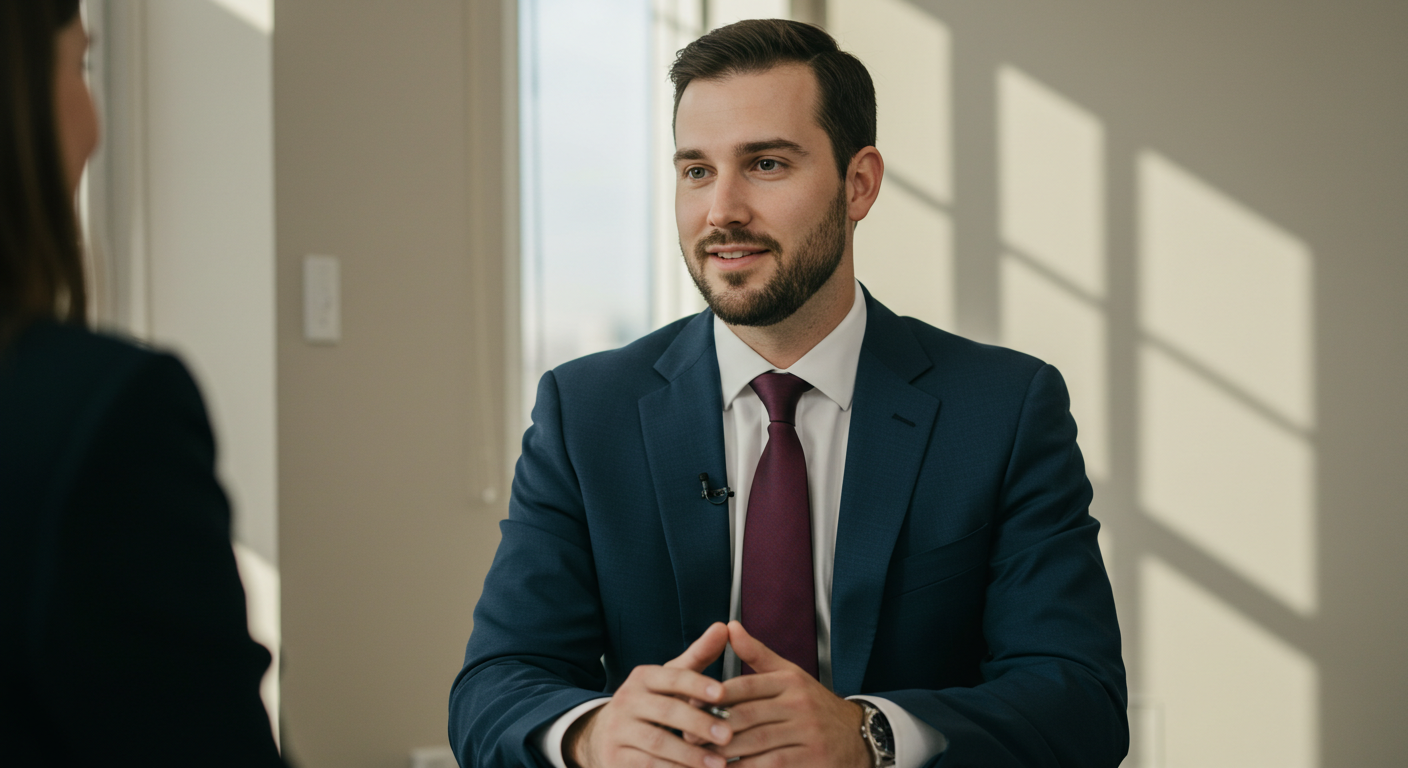
Body Language During the Interview
Eye Contact
- Maintain 60-70% eye contact
- Look away naturally to think or pause
- Avoid darting or shifting eyes, which signals anxiety
Facial Expressions
- Smile when appropriate
- Use eyebrows and eye movement to show interest
- Avoid expressions that seem forced or exaggerated
Posture and Positioning
- Lean in slightly to show interest
- Avoid slouching or leaning too far back
- Keep your torso open and shoulders relaxed
Gestures
- Use your hands to emphasize points
- Avoid over-gesturing or fidgeting
- Keep gestures below shoulder level and above waist
Voice and Tone
- Speak clearly and at a steady pace
- Lower your voice slightly to convey authority
- Avoid monotone delivery and vocal fillers
Managing Interview Nerves and Body Language
💡 Cues Tip: Recognize your nervous habits early and develop strategies to manage them before they become distracting during your interview.
Recognize Nervous Habits
Common signs include:
- Leg bouncing
- Face touching
- Excessive blinking
- Lip biting
Reduce Tension
- Breathe deeply before and during the interview
- Focus attention on the interviewer, not yourself
- Pause and smile before answering questions
Ending the Interview Professionally
Closing Moments
- Stand with poise
- Smile, maintain eye contact, and say thank you
- Shake hands if offered again
Exiting the Room
- Walk out confidently
- Avoid slouching or breaking posture too early
Body Language for Virtual Interviews
Virtual interviews present unique challenges for nonverbal communication. While the medium is different, the principles remain the same—your body language must convey confidence, engagement, and professionalism.
Video interviews still require strong body language:
- Sit upright and face the camera
- Look at the lens when speaking
- Keep hands visible and use them naturally
- Ensure your face is well-lit
- Nod and smile to show active listening
Interview Body Language Do's and Don'ts
Do:
- Make consistent eye contact
- Sit with an upright posture
- Smile appropriately
- Use natural gestures
- Mirror the interviewer subtly
Don't:
- Cross your arms or legs tightly
- Slouch or lean too far back
- Touch your face or hair repeatedly
- Stare or avoid eye contact entirely
Pre-Interview Body Language Preparation: Your 48-Hour Checklist
Use this systematic preparation guide in the 48 hours before your interview to ensure your body language supports your success:
48 Hours Before: Mental & Physical Rehearsal
- Record yourself: Film a 5-minute mock interview. Review your posture, eye contact, gestures, and facial expressions. Note three specific improvements to focus on.
- Practice power poses: Spend 2 minutes in expansive postures (arms raised, chest open) to boost confidence hormones and reduce stress cortisol.
- Identify nervous habits: List your top 3 nervous tells (face touching, leg bouncing, fidgeting) and practice redirect strategies like placing hands calmly on the table.
- Visualize success: Close your eyes and imagine walking in confidently, delivering a firm handshake, maintaining steady eye contact, and answering questions with calm, purposeful gestures.
24 Hours Before: Logistical Body Language Setup
- Choose your outfit: Select clothing that fits well, feels comfortable, and allows natural movement. Test sitting and standing in it to ensure it doesn't restrict posture.
- Test your interview space (virtual): If remote, check camera angle (eye level), lighting (face clearly lit), and background (uncluttered). Practice looking at the camera lens, not the screen.
- Plan your arrival: Research the location and plan to arrive 10-15 minutes early. This buffer prevents rushed, stressed body language and allows you to reset with deep breathing before entering.
- Prepare conversation anchors: Write down 2-3 key points you want to emphasize. When discussing these, practice using purposeful hand gestures at chest level to enhance your message.
Day Of: Final Body Language Calibration
- Morning power routine: Upon waking, stand in a power pose for 2 minutes. Throughout the morning, consciously maintain upright posture to build muscle memory.
- 15 minutes before: Find a private space. Do 3 deep breathing cycles (4-count inhale, 4-count hold, 6-count exhale) to calm your nervous system. Roll your shoulders back and down 5 times.
- 5 minutes before: Review your key talking points while standing in confident posture. Practice your opening handshake greeting in the mirror. Smile genuinely—it will relax your facial muscles and improve your first impression.
- Entrance moment: Walk in with purpose, stand tall with shoulders back, make eye contact with everyone in the room, deliver a firm (not crushing) handshake, and sit only after offered with upright but relaxed posture.
Pro Tip: The Mirror Effect
During the interview, subtly mirror the interviewer's energy level and posture (but not mechanically). If they lean forward engaged, lean in slightly. If they're more formal and upright, maintain professional distance. This creates subconscious rapport without appearing inauthentic.
Conclusion: Mastering Your Nonverbal Interview Skills
Body language speaks volumes in interviews. When aligned with your words, it creates a powerful, credible impression that helps you stand out. These same principles of effective nonverbal communication apply across all professional interactions.
By improving your awareness and control over nonverbal communication, you send the message that you're not only qualified, but emotionally intelligent and self-aware. These are traits highly valued by employers. Whether you're starting conversations at networking events or presenting in important meetings, mastering these skills will serve you throughout your career.
Body Language Glossary
Key terms and concepts used throughout this guide. Understanding these fundamentals will help you master body language reading skills.
- Power Posing
- Adopting expansive, open body positions before high-stakes situations to boost confidence hormones and reduce stress. Research shows 2 minutes of power posing before interviews can improve performance.
- Mirroring
- Subtly matching the interviewer's body language, posture, and energy level to build rapport and create a sense of connection. Should be done naturally, not mechanically.
- Open Posture
- A body position with uncrossed limbs, chest facing forward, and arms visible, signaling receptiveness, confidence, and honesty. Contrasts with defensive closed postures.
- Nonverbal Leakage
- Unconscious body language signals that reveal true emotions or stress levels, such as fidgeting, face touching, or tense shoulders. Common under interview pressure.
- Proxemics
- The study of personal space in communication. In interviews, maintaining appropriate distance (3-4 feet) shows respect while sitting too far appears disengaged.
🎯 Practice Makes Perfect
To practice in realistic scenarios, try Cues, the interactive app that trains you with real-world social dynamics, video simulations, and over 1,000 professional body language cues. Prepare with confidence, perform with clarity, and leave every interview with your best impression.